
Timing tensioner replacement
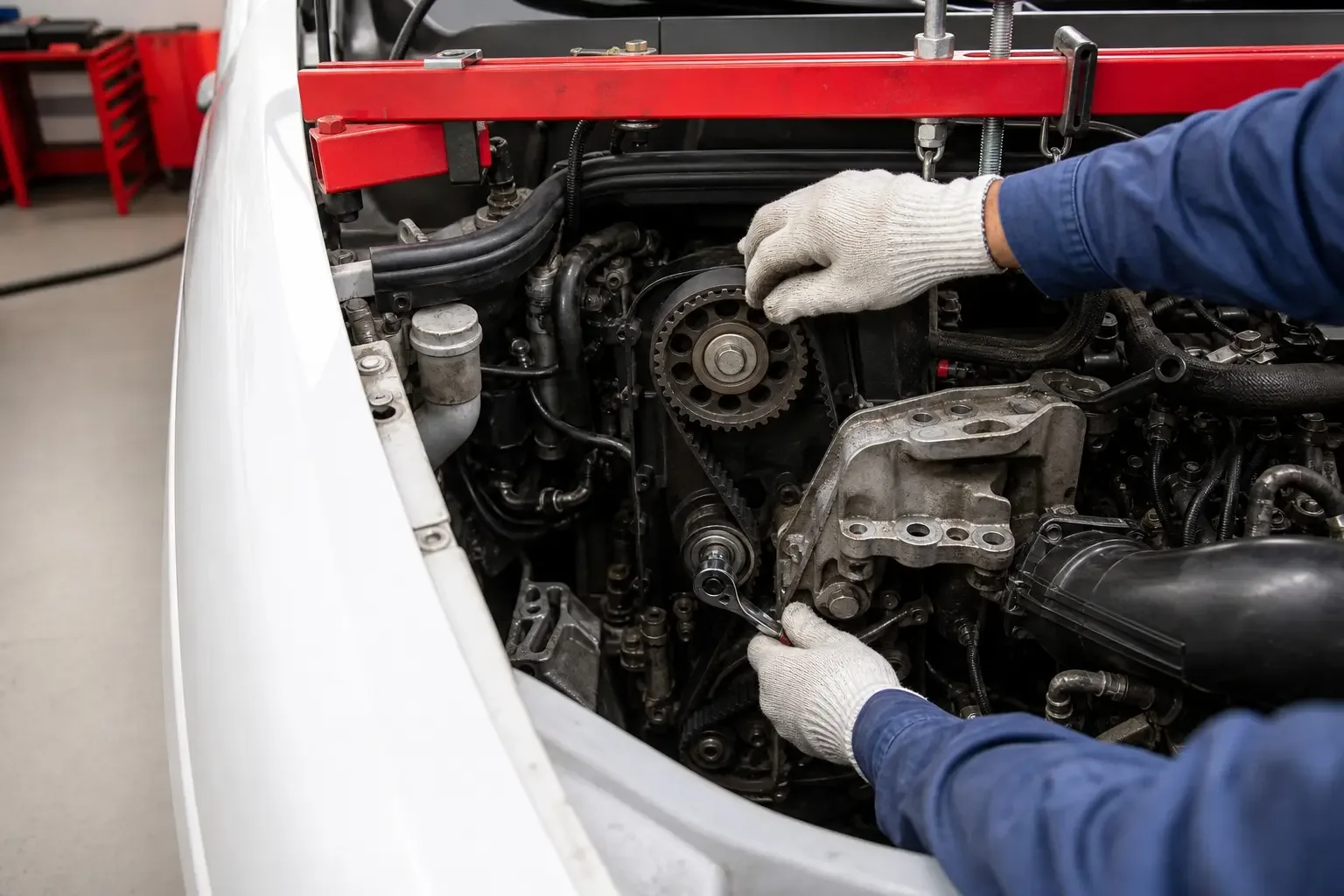
The tensioner maintains the correct belt or chain tension, directly affecting valve-timing accuracy.
Symptoms
- Rattling at startup, noise that fades after warm-up, cam/crank signal mismatch faults.
What's included
- A hydraulic tensioner gradually loses its ability to hold pressure; a mechanical one develops spring and housing wear. Symptoms include rattling at startup, noise that disappears when warm and crankshaft/camshaft signal-correlation faults. We inspect the tensioner whenever working on the timing system and do not pair an old one with a new belt or chain, a common cause of repeat repairs. After replacement, we always check tension and timing and, where fitted, the operation of the cam phasers.
Additional checks
- Hydraulic tensioner's ability to hold pressure, or spring/housing wear on a mechanical one
- Operation of cam-phaser couplings (where fitted)
Why it matters
An old tensioner isn't paired with a new belt or chain — that's the most common cause of a repeat repair. Tension and timing are checked after replacement.
More details
The tensioner keeps the belt or chain at the correct tension — the accuracy of the valve timing depends directly on it. A hydraulic tensioner loses its ability to hold pressure over time, while a mechanical one wears out at the spring and housing. Symptoms include a rattle on startup, noise that disappears after warm-up, and fault codes for crank-cam signal mismatch. We inspect the tensioner every time we work on the timing system and never install an old one alongside a new belt or chain — that's the most common cause of repeat repairs. After replacement we always check the tension and the valve timing, and on engines with variable valve timing, also the operation of the phasers.
Need a Technician Consultation?
Describe the vehicle and symptoms, and we will suggest which check to start with.
Book a Diagnostic